
We Forget Our Pleasures; We Remember Our Sufferings (series), Asma Sultana
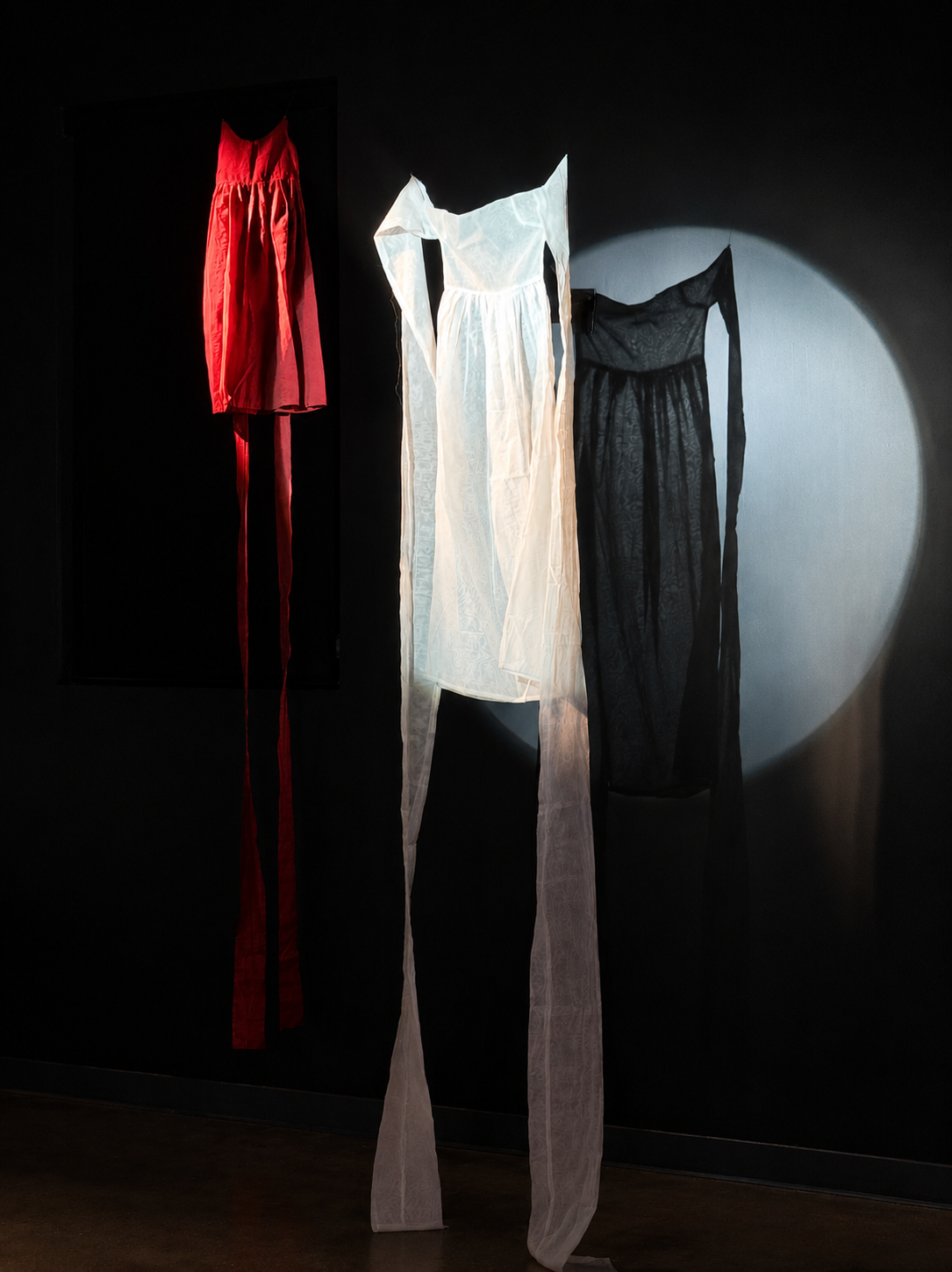
Three sleeveless dresses made from translucent fabric are suspended against a black gallery wall. Arranged from left to right in red, white, and black, each dress features elongated strips of fabric extending from the hem to the floor, creating vertical lines that emphasize height and gravity. Dramatic lighting isolates each garment against the dark background, with a circular spotlight illuminating the white and black dresses while the red dress glows from within its own shadowed niche. The installation highlights the transparency, texture, and delicate folds of the fabric, inviting associations with absence, memory, identity, and the body through the presence of unoccupied garments.
Title: We Forget Our Pleasures; We Remember Our Sufferings (series)
Artist: Asma Sultana
Date: 2024
Medium/Materials: Embroidery with artist's hair, and fabric (Bangladeshi cotton sari)
Dimensions: Variable
Form/Genre: Embroidery, textile art
Key Terms/Subject/Tags: Uterus; Emotion; Patient narrative; Reproductive system
Artist Statement:
Through Sultana’s autobiographical work, she seeks the truth of her identity as a diasporic, immigrant, displaced, freethinking minority woman—moving from the deeply personal to the universal. Her practice evolves from an ongoing quest to understand herself, her culture, her homeland, the world, and the universe that she inhabits. She constructs, deconstructs, and reconstructs lived experiences across East and West, weaving together fragmented memories and identities.
Central to her process is Sultana’s uprooted hair strands, which she collects, cleans, and stores meticulously—a mindful ritual akin to nurturing life itself. She uses it as a thread to embroider dresses, patterns, portraits, and installations, giving her biological existence tangible presence in art. Her discarded hair, a filamentous biomaterial containing dead cells and her DNA, becomes a literal self-portrait. She also draws with thumbs and fingers instead of brushes, applying ink directly to surfaces, and modifies everyday objects by embedding preserved hair.
This approach reflects natural cycles: hair falls from bodies as leaves from trees or seeds disperse for migration and renewal—displacement as an eternal part of life. Sultana’s multidisciplinary work blends media, techniques, and concepts to capture the complexity of existence across time and space.
Rooted in Bangladeshi heritage, textiles and embroidery evoke Bengal’s rich legacy, including the revered Nakshi Kantha hand-stitched quilts preserved in museums worldwide. Long, dark black hair symbolises female beauty in Sultana’s culture, inherited through generations. By cherishing and reinterpreting this tradition with a contemporary twist, she honours ancestral identity while exploring its relevance today.
Cultural Context / Story Behind the Work:
We Forget Our Pleasures; We Remember Our Sufferings (series). It explores the human tendency to focus on pain and hardship rather than fleeting moments of joy. This piece delves into the emotional and psychological depths of memory, emphasising how suffering often leaves a more profound impact on our consciousness. By using personal and cultural symbols, the artwork reflects on the ways in which these enduring memories of struggle shape our identities and life experiences, inviting viewers to contemplate the complex interplay between joy and suffering in their own lives. Sultana incorporates textiles and organic materials like strands of her hair, fabric, and found objects, merging them with mixed media to transform the familiar. By repurposing everyday elements, she seeks to lighten the burden of waste and breathe new life into forgotten things. Sultana’s art reflects her life's journey, weaving together the threads of migration, the restless nature of a nomadic existence, and the intricate layers of modern life far from home. Hair, a filamentous biomaterial containing dead cells and DNA, is integral to her work in general.
Rights for this Image:
This digital image is licensed under CC BY-NC 4.0. You are free to share it for non-commercial purposes, as long as you credit the artist.
Learn More:
asmasultana.com