
Bearing What Is Not There, Judy Duggan-McCormack
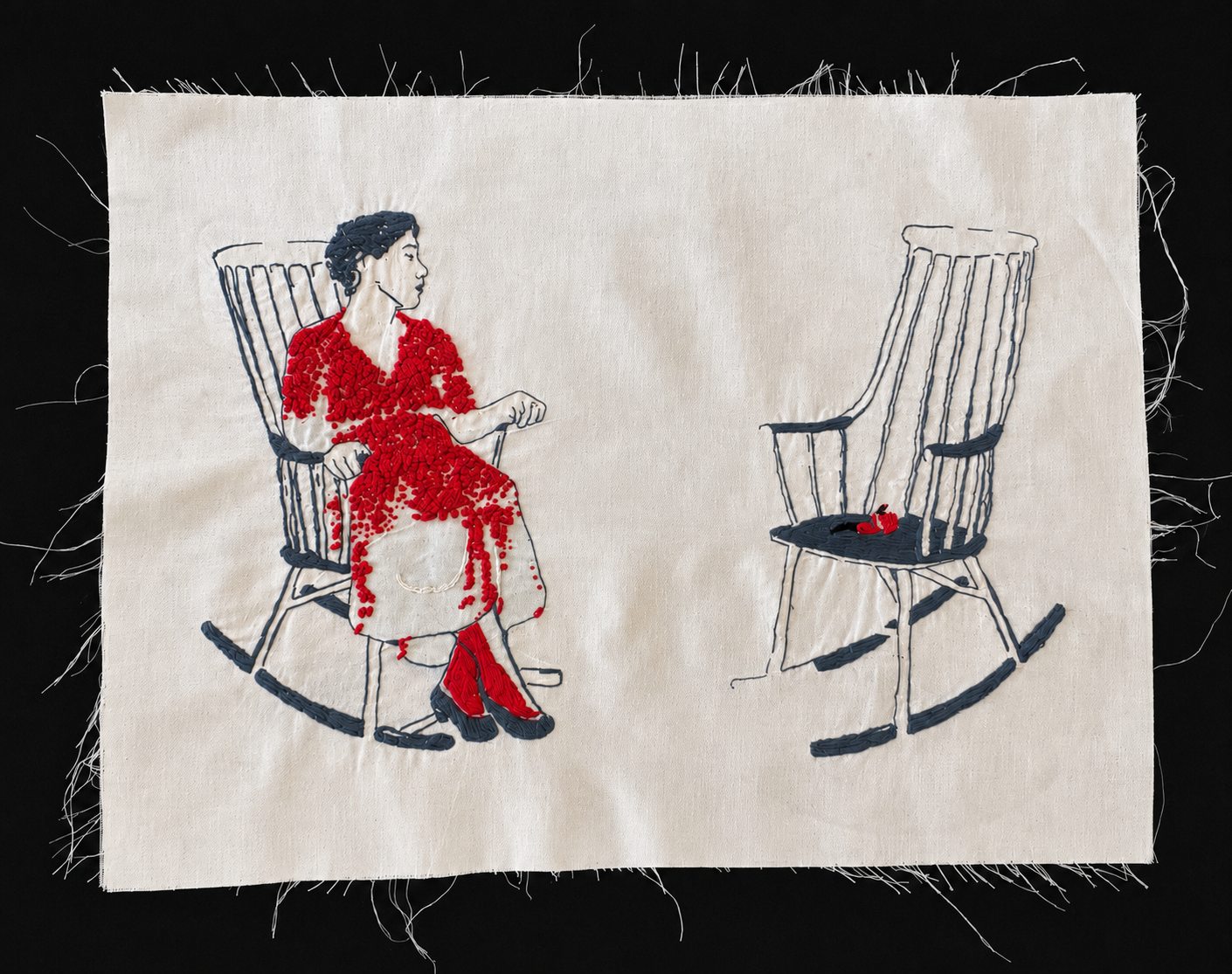
A hand-embroidered image on vintage cotton depicts a woman seated in a wooden rocking chair, positioned slightly left of center. She faces right toward a second, empty rocking chair. A small red pipe rests on the seat of the empty chair. The background is a flat, muted field with no detailed setting. The woman has short, dark hair and wears a white blouse densely stitched with red thread forming clustered, organic shapes. Similar red stitching extends down the front of her dark skirt and into her tall boots. Her arms are bent at the elbows, with one hand resting near her lap. The wooden rockers are outlined in dark thread with visible curved runners. The embroidery uses predominantly black and red thread, with the red stitching appearing raised and textured against the smoother fabric surface.
Title: Bearing What Is Not There, Judy Duggan-McCormack
Artist: Judy Duggan-McCormack
Date: 2026
Medium/Materials: Embroidery on vintage cotton
Dimensions: 46 cm x 57 cm
Form/Genre: Embroidery
Key Terms/Subject/Tags: Grief; Love; Identity
Artist Statement:
This hand-embroidered work considers the quiet architectures of grief and the bodies that carry it. A seated woman occupies a wooden rocking chair, turned toward an empty companion chair where a pipe rests in proxy for an absent figure. The scene borrows the visual language of mid-century domestic illustration, yet dense accumulations of crimson thread disrupt its calm surface. What reads initially as decorative patterning reveals itself as weight—stitched matter that settles, seeps, and insists.
The vintage cotton ground is integral to the work. Its softened fibres and subtle wear hold prior histories, suggesting that cloth, like the body, absorbs what it endures. Through thousands of deliberate hand stitches, Judy Duggan-McCormick builds raised fields of red that sit visibly atop the fabric. The repetitive act of piercing and pulling thread mirrors the cyclical motion of the rocking chair: a rhythm associated with caregiving, waiting rooms, vigils, and long recoveries.
The empty chair marks a threshold—between presence and absence, life and afterlife, diagnosis and aftermath. The pipe suggests identity without a body, habit without breath. The figure’s sideways glance becomes a gesture of bearing witness, holding space for what is no longer there.
Within the context of health humanities, this piece reflects on how identities are shaped through illness, loss, and care. Textile—historically aligned with domestic labour and gendered expectation—becomes a site where private sorrow is made visible. Here, grief is not silent; it is carried, stitched, and shared.
Cultural Context / Story Behind the Work:
Created after a year of substantial loss and several months of Duggan-McCormick’s own life-altering medical emergency.
Rights for this Image:
This digital image is licensed under CC BY-NC 4.0. You are free to share it for non-commercial purposes, as long as you credit the artist.
Learn More:
Instagram: @jdmoriginals